
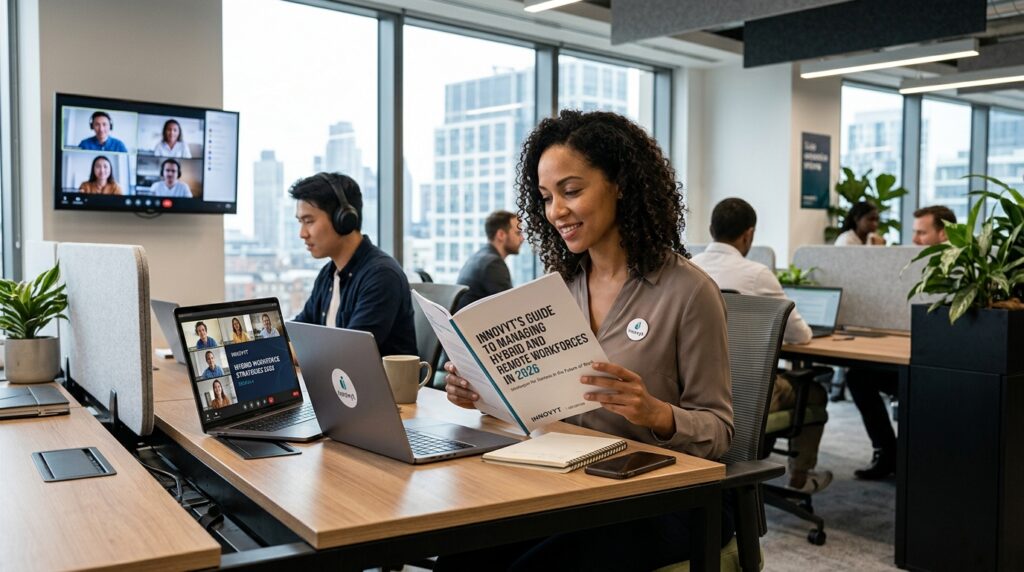
Work has changed permanently, and organizations entering 2026 are no longer asking whether flexible work models are sustainable. The real challenge is learning how to operate efficiently while supporting productivity, collaboration, accountability, and employee experience across multiple environments. Teams are no longer gathered in a single office every day, and leaders are expected to build systems that work across home offices, coworking spaces, regional hubs, and traditional workplaces.
This shift has made hybrid workforce management increasingly important for companies that want to remain competitive while creating environments employees actually want to be part of. Flexible work structures offer enormous advantages, but they also introduce challenges that cannot be solved with old leadership methods. Communication gaps, uneven visibility, engagement concerns, and operational inconsistencies appear quickly when organizations fail to adapt.
At the same time, companies are recognizing that success depends on intentional systems rather than location alone. Effective remote workforce management is no longer treated as a temporary adjustment but as a long-term business capability that affects culture, performance, and growth.
Innovyt’s approach for 2026 focuses on building operational clarity while creating flexibility that supports both business outcomes and employee success.
Redefining Work Around Outcomes Instead of Presence
One of the most significant changes shaping the workplace is the movement away from measuring activity and toward measuring results. For years, many organizations equated visibility with productivity, but distributed environments challenge that assumption.
Modern leaders understand that employees do not necessarily perform better simply because they are physically present. Instead, performance improves when expectations are clear, communication is consistent, and goals are measurable.
This shift has placed hybrid workforce management at the center of operational planning. Organizations increasingly recognize that effective leadership means building systems that support work regardless of where it happens.
Successful companies also understand that hybrid work best practices require managers to establish shared expectations across teams while maintaining enough flexibility to accommodate different working styles.
As organizations continue evolving, leaders must learn how to manage remote teams without creating unnecessary oversight that reduces trust or slows decision-making.
At the same time, stronger processes for distributed team management help organizations maintain alignment across departments and improve overall execution.
Communication Is Becoming a Strategic Function
Communication failures remain one of the most common reasons flexible work models struggle.
In traditional workplaces, information often spreads naturally through informal interactions. Hybrid and remote environments require communication to become intentional.
Leaders must create systems that ensure employees receive information consistently regardless of location.
Organizations investing in hybrid workforce management increasingly focus on communication architecture rather than simply increasing meetings.
This also strengthens remote workforce management because teams gain greater clarity around expectations and decision-making processes.
Companies implementing stronger communication systems often discover that hybrid work best practices depend less on technology and more on consistency.
Leaders who successfully manage remote teams create communication rhythms that support productivity without overwhelming employees.
Strong communication structures also improve distributed team management by reducing duplication and preventing teams from becoming disconnected.
Building Culture Across Multiple Work Environments
Culture can no longer depend on physical proximity.
Many organizations entering 2026 are discovering that employee connection requires active design rather than office attendance.
Employees want flexibility, but they also want clarity, recognition, and meaningful collaboration.
This is why hybrid workforce management has become closely connected with culture strategy.
Organizations succeeding in flexible environments intentionally create moments for connection while respecting employee autonomy.
At the same time, strong remote workforce management ensures remote employees remain included in decisions and development opportunities.
Companies following effective hybrid work best practices increasingly focus on equal access to information and participation.
Managers who learn to manage remote teams effectively often discover that culture improves when expectations become clearer.
Well-designed distributed team management also reduces the sense of separation that employees sometimes experience across locations.
Leadership Expectations Are Evolving in 2026
Leadership today looks different than it did only a few years ago.
Managers are expected to support outcomes, encourage autonomy, and remove barriers rather than control every process.
This transition requires new skills.
Organizations strengthening hybrid workforce management increasingly invest in manager capability because leadership behavior shapes employee experience more than policies alone.
Strong remote workforce management depends on managers who can coach effectively while creating accountability.
Many businesses adopting stronger hybrid work best practices are redesigning leadership development around communication, decision-making, and team coordination.
Managers who successfully manage remote teams create environments where employees understand expectations and feel empowered to deliver.
As organizations grow, scalable distributed team management becomes essential for maintaining consistency across departments.
Technology Should Support Work, Not Control It
Technology remains essential, but companies increasingly recognize that tools alone do not solve collaboration challenges.
Organizations often adopt too many platforms and create unnecessary complexity.
Instead, successful companies simplify workflows and align tools with employee needs.
Effective hybrid workforce management depends on creating digital environments that support execution without adding friction.
At the same time, modern remote workforce management requires visibility into progress rather than constant monitoring.
Businesses implementing sustainable systems understand that hybrid work best practices prioritize usability and adoption.
Technology also plays an important role for leaders trying to manage remote teams efficiently across different schedules and locations.
When implemented intentionally, technology strengthens distributed team management and improves operational clarity.
Performance Management Is Becoming More Transparent
Traditional performance reviews often struggle in flexible environments.
Employees want clearer expectations and more frequent feedback.
Organizations are increasingly replacing annual evaluation cycles with ongoing conversations and measurable outcomes.
This shift makes hybrid workforce management more effective because employees understand priorities more clearly.
Businesses investing in stronger remote workforce management are also creating more transparent performance frameworks.
Companies adopting modern hybrid work best practices emphasize coaching and continuous development.
Managers who consistently manage remote teams often create stronger engagement because employees receive clearer guidance.
More structured distributed team management also helps organizations maintain fairness across different work arrangements.
Flexibility Requires Accountability
One of the biggest misconceptions about flexible work is that flexibility reduces accountability.
In reality, successful organizations create stronger accountability because expectations become more explicit.
Employees benefit from knowing how success is measured and how their work contributes to larger objectives.
Organizations improving hybrid workforce management understand that trust and accountability work together.
Leaders focused on better remote workforce management create systems that encourage ownership rather than supervision.
Businesses implementing mature approaches increasingly treat distributed team management as a capability that strengthens long-term resilience.
Companies that continue refining these systems position themselves to adapt more effectively as workplace expectations continue evolving.
Preparing for the Future of Work
The organizations that succeed in 2026 will not necessarily be those with the most office space or the most flexible policies. Success will belong to companies that create clarity, empower employees, and operate with intentional systems.
Investing in hybrid workforce management allows businesses to build environments where employees can contribute effectively across locations.
Companies that continue improving remote workforce management are creating stronger foundations for growth and adaptability.
Leaders who learn how to manage remote teams consistently will be better positioned to attract talent and improve execution.
At the same time, businesses strengthening distributed team management are preparing themselves for a future where flexibility becomes a normal expectation rather than a competitive advantage.
Ultimately, sustainable success will come from combining structure with trust and adapting workplace systems to support how people actually work.
Final Thoughts
The workplace in 2026 is defined less by location and more by experience, outcomes, and operational clarity. Organizations that embrace this shift thoughtfully will create stronger cultures and more resilient teams.
By prioritizing hybrid workforce management, companies can build systems that support collaboration and performance across changing work environments.
Strengthening remote workforce management, adopting practical hybrid work best practices, learning how to manage remote teams, and investing in long-term distributed team management will help organizations create workplaces designed for the future rather than anchored to the past.
FAQ’S
Q: Why is outcome-based management becoming more important in hybrid and remote workplaces in 2026?
A: Outcome-based management helps organizations focus on measurable results rather than employee visibility. As highlighted by Innovyt, successful hybrid workforce management depends on clear expectations, accountability, and performance metrics that work across multiple locations. This approach builds trust, improves productivity, and allows employees to perform effectively regardless of where they work.
Q: How can companies improve communication in a hybrid workforce without increasing meetings?
A: Companies can strengthen communication by creating structured and consistent communication systems instead of relying on frequent meetings. Innovyt emphasizes that effective hybrid workforce management requires intentional communication processes that keep employees informed, aligned, and connected while reducing information gaps and unnecessary interruptions.
Q: What role does company culture play in successful remote workforce management?
A: Company culture remains essential in flexible work environments, but it must be intentionally designed rather than built through physical proximity alone. According to Innovyt, organizations that prioritize recognition, inclusion, collaboration, and equal access to opportunities create stronger connections among employees and support long-term engagement across distributed teams.
Q: How are leadership expectations changing for managers overseeing remote teams?
A: Modern managers are expected to guide outcomes, support autonomy, and remove obstacles instead of closely controlling daily activities. Innovyt notes that effective remote workforce management relies on leaders who can coach employees, communicate clearly, and create accountability while empowering teams to make decisions and achieve goals independently.