
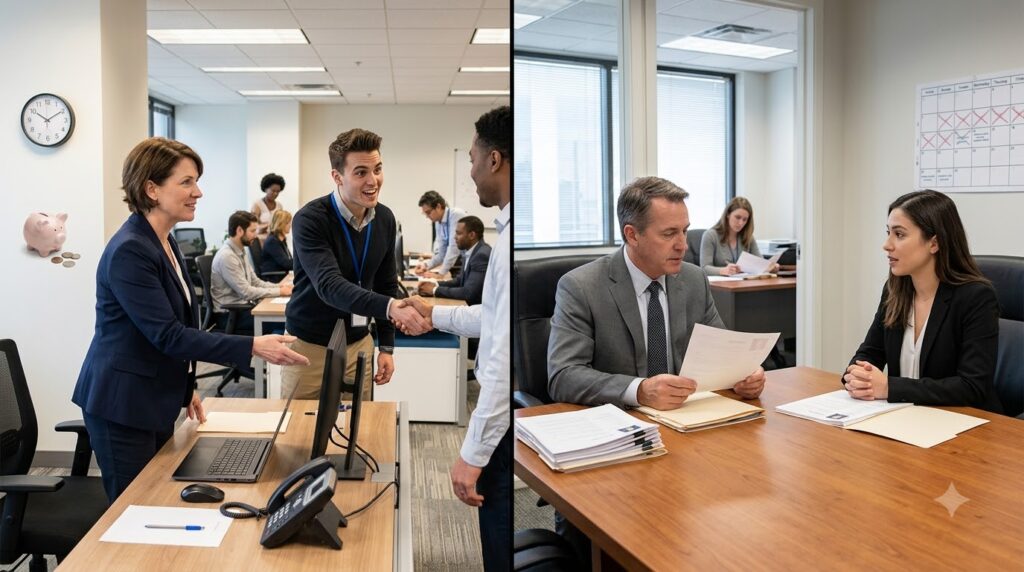
Choosing between contract staffing and direct hiring affects more than recruitment costs. It influences how quickly a role is filled, how easily the workforce can scale, who manages payroll and administration, and how much long-term knowledge remains within the company.
Neither model is automatically cheaper or better.
Contract staffing generally works best for urgent, temporary, project-based, or specialized requirements. Direct hiring is usually more suitable for permanent roles that require long-term ownership, leadership, customer relationships, or institutional knowledge.
Many businesses achieve the best balance by using permanent employees for core functions and contract professionals for changing workloads or specialized projects.
This guide compares contract staffing vs direct hiring across the factors that matter most, including hiring speed, total cost, flexibility, compliance, retention, and return on investment.
What Is Contract Staffing?
Contract staffing is a workforce model in which a professional works for a client organization for an agreed period or assignment, usually through a staffing provider.
Depending on the arrangement, the staffing company may manage:
- Candidate sourcing and screening
- Employment documentation
- Payroll processing
- Benefits administration
- Tax withholding
- Background checks
- Assignment management
- Replacement support
The client organization typically manages the worker’s daily responsibilities, project expectations, workplace access, and performance on the assignment.
Innovyt provides IT staffing solutions for contract, full-time, and project-based roles, allowing businesses to select a workforce model based on their operational requirements.
Contract staffing is not necessarily independent contracting
A contract professional supplied by a staffing agency is often an employee of that agency. This is different from hiring a self-employed independent contractor.
Worker classification depends on the actual relationship, including behavioral control, financial control, and the relationship between the parties. A contract label alone does not determine whether someone is legally an employee or an independent contractor.
What Is Direct Hiring?
Direct hiring means the candidate joins the client organization as its permanent employee.
The company becomes responsible for the complete employment relationship, including:
- Salary and payroll
- Employee benefits
- Tax and employment documentation
- Onboarding
- Training
- Performance management
- Career development
- Retention
- Workplace policies
- Separation or termination processes
The employer may recruit the employee internally or use a staffing agency to identify and evaluate candidates. In either case, the selected person becomes an employee of the hiring company rather than remaining on the staffing provider’s payroll.
Direct hiring is commonly used for:
- Leadership positions
- Department heads
- Long-term technical roles
- Customer-facing positions
- Core operational functions
- Roles requiring company-specific knowledge
- Positions connected to succession planning
Contract Staffing vs Direct Hiring: Quick Comparison
| Factor | Contract staffing | Direct hiring |
| Employment duration | Fixed term, project-based, or flexible | Ongoing or permanent |
| Hiring speed | Often faster for urgent requirements | Usually involves a longer selection process |
| Upfront commitment | Lower long-term commitment | Higher long-term commitment |
| Workforce flexibility | High | Moderate |
| Payroll administration | Commonly handled by staffing provider | Handled by the employer |
| Benefits administration | Depends on the staffing agreement | Managed by the employer |
| Knowledge retention | May require a formal handover | Usually stronger over time |
| Company integration | Depends on assignment length | Generally deeper |
| Best suited for | Projects, demand spikes, niche skills, interim coverage | Leadership, core teams, long-term ownership |
| Main cost advantage | Avoids unnecessary permanent capacity | Builds long-term value in continuing roles |
The best model depends on the role, duration, urgency, required expertise, and expected business value.
Which Hiring Model Saves More Time?
Contract staffing usually saves time when the need is urgent
Contract staffing can shorten the recruitment cycle because an established staffing partner may already have:
- Candidate networks
- Pre-screened talent
- Recruiters familiar with specialized roles
- Existing screening processes
- Payroll and onboarding systems
- Replacement procedures
This makes contract staffing useful when:
- A project is starting soon
- A critical employee is temporarily unavailable
- A deadline cannot wait for a permanent recruitment cycle
- Seasonal demand has increased
- The company needs a specialist for a limited period
- A permanent role has not yet been approved
The time saved is not limited to sourcing candidates. The client may also reduce the internal time spent on payroll setup, benefits administration, documentation, and routine employment coordination.
However, contract staffing is not automatically fast. Results still depend on the availability of the required skills, location, compensation, screening requirements, and staffing partner.
Direct hiring takes longer but may prevent repeated recruitment
Direct hiring usually requires more evaluation because the employee may remain with the company for years.
The process may involve:
- Workforce planning
- Job description development
- Candidate sourcing
- Multiple interviews
- Skills assessments
- Reference checks
- Compensation approval
- Offer negotiations
- Notice periods
- Permanent onboarding
This additional time can be worthwhile when the role requires leadership, cultural alignment, long-term customer ownership, or deep knowledge of the organization.
A rushed permanent hire can create more disruption than leaving the position open slightly longer.
Time-saving verdict
Choose contract staffing when immediate capability matters more than long-term integration.
Choose direct hiring when the cost of selecting the wrong long-term employee is greater than the cost of a longer hiring process.
Which Hiring Model Saves More Money?
The correct comparison is not:
Contract hourly rate vs permanent salary
The correct comparison is:
Total cost of obtaining the required business outcome
A contract worker may have a higher hourly bill rate, but the company may use that worker only for the exact duration required. A permanent employee may have a lower apparent hourly cost, but the organization assumes ongoing compensation, benefits, administration, training, and retention responsibilities.
Total cost of contract staffing
The total cost may include:
- Staffing agency bill rate
- Assignment duration
- Overtime or shift premiums
- Client-specific training
- Equipment and software access
- Internal supervision
- Knowledge transfer
- Contract extensions
- Conversion fee, when the worker is hired permanently
The staffing provider’s fee commonly covers services such as sourcing, screening, payroll, employment administration, and its operating margin.
Contract staffing may save money when:
- The requirement has a fixed end date
- Demand is uncertain
- The skill is needed only temporarily
- A vacancy is delaying a revenue-generating project
- Building permanent internal capacity would create unnecessary fixed cost
- The company lacks recruitment expertise for a niche role
Total cost of direct hiring
The total cost may include:
- Recruitment advertising
- Recruiter or agency fees
- HR and interview time
- Background checks
- Salary
- Payroll taxes
- Insurance and benefits
- Paid leave
- Equipment
- Onboarding
- Training
- Performance management
- Retention initiatives
- Vacancy time
- Turnover and replacement costs
These costs are not automatically wasteful. They can produce substantial value when the employee contributes over a long period.
Direct hiring may save money when:
- The work is continuous
- The role will remain necessary for several years
- The employee will develop valuable company knowledge
- Repeated contract extensions would cost more
- The position directly influences leadership, strategy, or customer retention
- The organization wants to develop internal capabilities
A simple cost comparison
Use this framework before choosing:
Contract staffing cost
Agency bill rate × expected hours + client onboarding costs + supervision + transition costs
Direct hiring cost
Salary + employment costs + recruitment + onboarding + training + vacancy cost + expected turnover risk
Then compare both totals over the same period, such as 6, 12, or 24 months.
A six-month project and a five-year operational position should not be evaluated using the same cost assumptions.
Cost-saving verdict
Contract staffing usually provides better cost control for short-term or uncertain requirements. Direct hiring generally creates better long-term value when the work is continuous and the employee’s knowledge compounds over time.
Which Model Provides More Flexibility?
Contract staffing offers greater numerical flexibility. Companies can increase or reduce assigned resources according to project requirements, seasonal demand, or workload.
It is useful for:
- Software implementation
- Cloud migration
- Cybersecurity projects
- Product launches
- Data migration
- Seasonal operations
- Temporary employee absence
- Business expansion
- Backlog reduction
Direct hiring provides less short-term flexibility but greater continuity.
Permanent employees are more likely to:
- Develop company-specific knowledge
- Build long-term customer relationships
- Support team culture
- Mentor new employees
- Improve internal processes
- Participate in succession planning
- Take ownership beyond one assignment
The right question is not simply, “Which model is more flexible?”
It is:
Does this role require flexible capacity or lasting organizational ownership?
Compliance and Responsibility: A Critical Difference
One of the biggest mistakes in contract staffing is assuming that the staffing agency carries every legal and workplace responsibility.
The exact responsibilities depend on the agreement, applicable law, and working relationship.
In temporary staffing arrangements, the staffing agency and host employer may share responsibilities. OSHA states that both parties can be jointly responsible for providing temporary workers with a safe work environment, including appropriate training, hazard communication, and recordkeeping.
Joint employment can also affect obligations under employment laws. The U.S. Department of Labor notes that joint employment commonly exists when a temporary employment agency supplies employees to another employer, although the analysis depends on the applicable law and facts.
Before starting a staffing engagement, document:
- Who employs and pays the worker
- Who controls daily work
- Who provides training
- Who supplies safety equipment
- Who tracks working hours
- Who approves overtime
- Who handles complaints
- Who manages leave and accommodation requests
- Who owns intellectual property
- Who manages confidential information
- What happens when the assignment ends
- How disputes and replacements are handled
The staffing agreement should be reviewed by qualified legal or HR professionals for the relevant location and industry.
Contract Staffing Pros and Cons
Advantages
- Faster access to available talent
- Flexible assignment duration
- Easier workforce scaling
- Access to specialized expertise
- Lower long-term commitment
- Reduced recruitment administration
- Potential replacement support
- Better cost control for defined projects
Limitations
- Agency markup can increase the hourly cost
- Contract workers may require client onboarding
- Knowledge can leave when the assignment ends
- Repeated extensions can become expensive
- Team integration may require extra effort
- Responsibilities may still be shared with the client
- Overdependence on temporary workers can weaken internal capability
Direct Hiring Pros and Cons
Advantages
- Stronger long-term knowledge retention
- Greater continuity
- Deeper company integration
- Better fit for leadership and core functions
- More opportunity for career development
- Stronger succession planning
- Potentially lower long-term cost for continuous work
Limitations
- Longer recruitment process
- Higher ongoing employment commitment
- More payroll and benefits administration
- Greater cost when demand falls
- Longer onboarding and development period
- Higher impact if the employee leaves soon after joining
When to Choose Contract Staffing
Contract staffing is usually the stronger choice when:
- The requirement has a defined timeline
- Workload may increase or decrease
- A project requires specialized expertise
- A critical vacancy needs temporary coverage
- The company needs to test a new function
- Permanent headcount is not approved
- Speed has significant business value
- The organization is entering a new market
- A transformation project needs additional capacity
Examples may include contract software developers, cloud engineers, data specialists, QA professionals, implementation consultants, or cybersecurity experts.
When to Choose Direct Hiring
Direct hiring is usually more suitable when:
- The work is permanent and predictable
- The role owns long-term strategy
- The employee will manage customers or teams
- Company-specific knowledge is essential
- The position affects culture or succession
- The employee will build internal systems
- The organization expects the role to grow
- Continuity is more valuable than short-term flexibility
Leadership, finance, HR, account management, operations, and core technical ownership roles often benefit from permanent employment.
When a Hybrid Workforce Works Best
Businesses do not need to use only one hiring model.
A hybrid workforce combines:
- Permanent employees for leadership, strategy, customer ownership, and core operations
- Contract professionals for projects, temporary demand, specialized expertise, and rapid scaling
For example, a technology company might directly hire:
- Engineering leaders
- Product managers
- Account managers
- Finance professionals
- HR leaders
It might use contract staffing for:
- Cloud migration
- Software development sprints
- Data engineering
- Quality assurance
- Cybersecurity assessments
- ERP implementation
This approach protects long-term knowledge while preventing the permanent workforce from becoming overloaded or unnecessarily large.
Five Questions to Choose the Right Hiring Model
1. How long will the work exist?
A temporary or uncertain requirement favors contract staffing. Continuous work favors direct hiring.
2. How quickly is the person needed?
When vacancy cost is high and the project cannot wait, contract staffing may provide faster access.
3. Is the skill needed permanently?
A specialist needed for one implementation may be better engaged through a contract. A capability central to the company’s future may need to be developed internally.
4. What is the true total cost?
Compare both models across the same period. Include vacancy, administration, onboarding, benefits, agency fees, and turnover risk.
5. What knowledge must remain inside the business?
If the role creates critical processes, intellectual property, customer knowledge, or leadership capability, direct hiring or a formal knowledge-transfer plan may be necessary.
Common Hiring Model Mistakes
Choosing based only on salary or hourly rate
An hourly contract rate and a permanent salary do not include the same services or obligations.
Better approach: Compare the total cost over the expected duration.
Assuming contract staffing removes every responsibility
The client may retain or share workplace, wage, safety, and management responsibilities.
Better approach: Define obligations clearly in the staffing agreement.
Using permanent hiring for uncertain demand
A permanent team built for a temporary workload can create avoidable fixed costs.
Better approach: Validate long-term demand before committing to permanent headcount.
Keeping contractors indefinitely without reviewing the model
Repeated extensions may become more expensive and can create operational or compliance concerns.
Better approach: Review long-running assignments and consider conversion, replacement, or knowledge transfer.
Ignoring onboarding for contract workers
Contract professionals still need access, expectations, security instructions, and role-specific training.
Better approach: Use a focused assignment onboarding process.
Failing to plan knowledge transfer
Projects can stall when expertise leaves with the contractor.
Better approach: Require documentation, handover sessions, and shared ownership before the assignment ends.
Frequently Asked Questions
What is the main difference between contract staffing and direct hiring?
In contract staffing, a professional works on a fixed-term or project assignment, commonly through a staffing provider. In direct hiring, the individual joins the client organization as its permanent employee.
Is contract staffing always cheaper?
No. It is often more cost-effective for short-term, specialized, or uncertain work. Direct hiring may provide better value when a role is needed continuously over several years.
Which hiring model is faster?
Contract staffing can be faster when the staffing provider has suitable candidates available. Direct hiring generally requires more evaluation because the organization is making a long-term employment decision.
Can a contract employee be hired permanently?
Yes. Some staffing agreements allow contract-to-hire conversion. The agreement should explain the conversion period, process, and any applicable fee.
Does a staffing agency handle all compliance responsibilities?
Not always. Responsibilities can be shared between the staffing agency and the client organization, depending on the working relationship, agreement, law, and issue involved.
Can a company use contract and permanent employees together?
Yes. A hybrid workforce can combine permanent employees for core responsibilities with contract professionals for flexible capacity and specialized projects.
Final Verdict: Contract Staffing or Direct Hiring?
There is no universal winner.
Choose contract staffing when the business needs:
- Faster access to talent
- Project-based expertise
- Flexible capacity
- Temporary coverage
- Lower long-term commitment
- Better control over uncertain demand
Choose direct hiring when the business needs:
- Long-term ownership
- Leadership development
- Institutional knowledge
- Customer continuity
- Strong team integration
- Permanent organizational capability
For many organizations, the most efficient answer is a hybrid strategy.
The objective should not be to minimize every hiring expense. It should be to choose the workforce model that delivers the required capability at the right time, with an acceptable level of cost, risk, and commitment.
Build a More Flexible Workforce with Innovyt
Innovyt supports businesses with staffing and workforce solutions designed around contract, full-time, and project-based talent requirements. Its staffing services focus particularly on connecting organizations with technology professionals for changing operational and project needs.
Whether a business needs specialized contract professionals, permanent team members, or a balanced workforce strategy, the hiring model should begin with a clear understanding of the role, timeline, budget, and expected long-term value.
A structured workforce plan can help reduce unnecessary hiring delays, improve access to relevant talent, and ensure that permanent and contract resources are used where they create the greatest business value.