
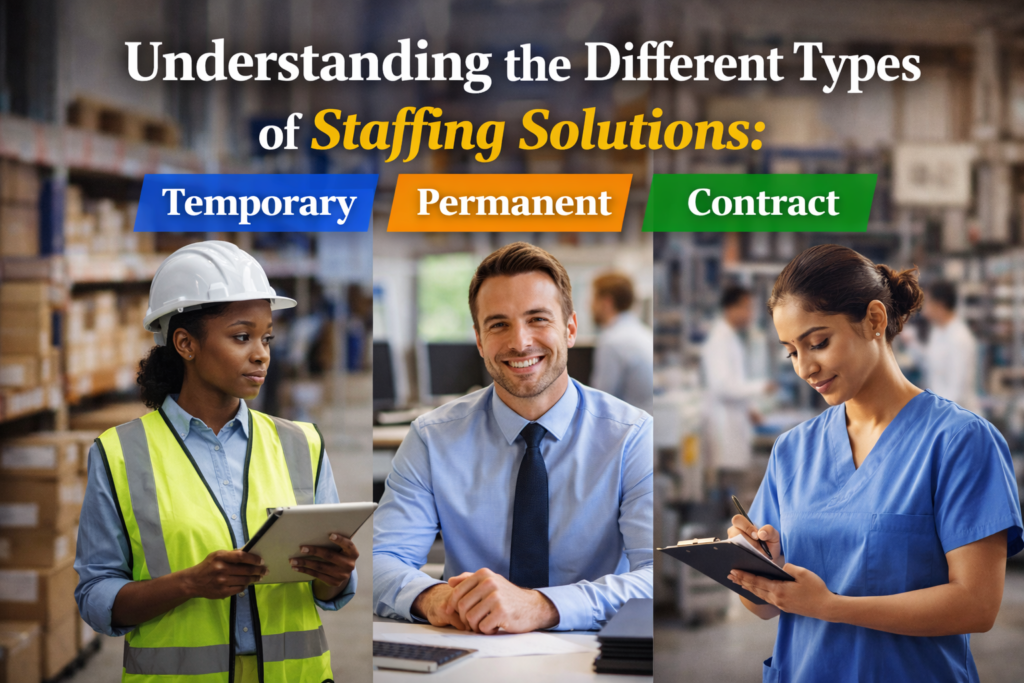
In today’s competitive and rapidly changing job market, companies must adapt to various staffing models to meet their workforce needs. As businesses continue to evolve, it’s essential to understand the different types of staffing solutions available to help make the most strategic hiring decisions. Whether it’s temporary staffing, permanent staffing, or contract staffing, each solution offers distinct advantages depending on a company’s goals, project requirements, and industry needs.
In this blog, we will explore the three primary staffing solutions—temporary staffing, permanent staffing, and contract staffing—and help you understand how to leverage them effectively. We’ll also discuss the benefits and drawbacks of each staffing type and provide insights into how Innovyt, the best staffing solutions company, can help you choose the right approach for your organization.
What Are Staffing Solutions?
Staffing solutions are the methods or approaches that companies use to hire employees or workers to meet their business needs. These solutions can be broadly categorized into three types: temporary staffing, permanent staffing, and contract staffing. Each type serves different business objectives and offers varying degrees of flexibility, cost, and commitment. The key to choosing the right staffing solution lies in understanding the specific needs of your organization, your budget, and the type of roles you’re hiring for.
Staffing solutions can provide businesses with the flexibility to scale their workforce up or down depending on the situation. For example, during busy seasons, a company might opt for temporary staffing to meet increased demand, while for long-term growth, permanent staffing may be a better option. Contract staffing offers flexibility in between these two extremes, providing skilled professionals for specific projects or time-limited needs.
Temporary Staffing: Flexibility and Quick Solutions
Temporary staffing involves hiring workers for short-term positions to meet immediate needs or fill gaps in the workforce. Temporary employees are often brought in to handle a surge in workload, cover for employees on leave, or provide additional support during peak periods.
One of the key advantages of temporary staffing is the flexibility it offers to both the employer and the employee. Companies can bring in temporary staff quickly without a long-term commitment, and temporary workers can gain experience across multiple industries without being tied down to a single employer.
For businesses, temporary staffing provides a cost-effective solution. There is less financial risk involved, as businesses are only responsible for paying for the worker during the duration of the assignment. Additionally, there are no long-term benefits such as healthcare or retirement plans to provide for temporary workers. This makes temporary staffing a great option for companies looking to fill short-term roles, such as seasonal work or project-based tasks.
However, there are also some challenges associated with temporary staffing. One of the main concerns is the potential lack of loyalty and consistency. Temporary employees may not feel as committed to the company as permanent staff members, and turnover can be high. Additionally, training and onboarding temporary workers can take time and resources, which can offset the benefits of their short-term nature.
Permanent Staffing: Long-Term Commitment to Growth
Permanent staffing is the process of hiring employees on a long-term basis with an ongoing commitment to the company. Permanent employees are typically hired for roles that are essential to the company’s daily operations and long-term growth. These employees usually receive full benefits, such as healthcare, paid time off, and retirement plans, and are expected to contribute to the company’s culture and success over time.
The primary advantage of permanent staffing is the long-term stability it provides both the company and the employee. By hiring permanent staff, businesses can build a committed, skilled workforce that is aligned with the company’s goals and culture. Permanent employees often bring continuity to the workplace, reducing turnover and providing more opportunities for career growth within the company.
Another key benefit of permanent staffing is that it helps foster a strong company culture. Permanent employees are more likely to be invested in the company’s mission, values, and vision, contributing to a collaborative and stable work environment. Companies that invest in their permanent staff through training and development often see increased productivity and higher employee morale.
On the flip side, permanent staffing can be more expensive than other staffing solutions. The hiring process can be lengthy, and businesses must invest in recruiting, onboarding, and training permanent employees. Additionally, the ongoing commitment to salaries, benefits, and compensation can strain a company’s budget, especially during slower periods or times of financial uncertainty.
Despite the higher costs associated with permanent staffing, this approach is often essential for companies seeking stability, deep industry expertise, and employees who will play a key role in the company’s long-term growth.
Contract Staffing: The Best of Both Worlds
Contract staffing is a middle ground between temporary staffing and permanent staffing. Contract workers are hired for a specific period or project, often with a clear start and end date. Unlike temporary staffing, which tends to be used for short-term roles, contract staffing typically involves more specialized positions, such as IT consultants, project managers, or engineers, and is often used for specific projects or time-sensitive tasks.
One of the biggest advantages of contract staffing is the flexibility it offers to both the employer and the employee. Companies can bring in skilled professionals for the duration of a project, and once the project is complete, the contract is finished. This reduces the financial commitment of permanent hires while still allowing the company to access high-level expertise when needed.
For employees, contract staffing provides the opportunity to work on diverse projects and gain experience across different companies and industries. It can be particularly appealing for professionals who prefer the variety and flexibility that comes with contract work. Many contract workers enjoy the ability to work on different projects without being tied to a single employer long-term.
The downside to contract staffing is the potential for a lack of continuity. While contract workers may be highly skilled, they are often not as invested in the company’s culture or long-term goals as permanent employees. Additionally, managing a contract staffing workforce can be more complex than managing permanent employees, as businesses must ensure that contracts are properly structured and adhered to.
When to Choose Temporary, Permanent, or Contract Staffing
The decision to choose temporary staffing, permanent staffing, or contract staffing depends on your company’s specific needs. Each staffing solution serves a different purpose, and understanding when to use each type is crucial to maintaining a balanced and effective workforce.
1. Temporary staffing is ideal for companies that experience seasonal fluctuations, need to cover for employees on leave, or require extra help during busy periods. If your organization needs short-term assistance with minimal commitment, temporary staffing is a great option.
2. Permanent staffing is the best choice for businesses looking for long-term stability and growth. If you are hiring for roles that are integral to your company’s daily operations and future development, permanent staffing ensures that you can build a skilled, committed workforce with a shared vision for success.3. Contract staffing is suitable for organizations that need specialized talent for specific projects or time-bound tasks. If your company requires high-level expertise for a limited duration, contract staffing gives you the flexibility to access skilled professionals without long-term commitments.
How Innovyt Can Help You Choose the Right Staffing Solution
At Innovyt, we specialize in providing the best staffing solutions for businesses across various industries. Whether you’re in need of temporary staffing, permanent staffing, or contract staffing, we work with you to understand your unique needs and offer tailored solutions that help your organization succeed.
Our team at Innovyt has a deep understanding of the ever-changing staffing landscape and can guide you in making the right staffing decisions based on your business goals. By leveraging our industry expertise and extensive network, we ensure that you get the best talent for your company’s needs, whether it’s a temporary fill-in, a permanent employee, or a contract worker with specialized skills.
Conclusion
Choosing the right staffing solution for your business is crucial for its success. Each type of staffing solution—temporary staffing, permanent staffing, and contract staffing—offers its own set of advantages, and understanding when and how to use them can help you build a more efficient, flexible, and skilled workforce.By partnering with a trusted staffing provider like Innovyt, you can ensure that your company is equipped with the right talent for any challenge, at any time. Whether you need a temporary worker for a short-term project, a permanent hire for long-term growth, or a contract professional to fill a specific role, Innovyt’s expert staffing solutions can help you make the best decision for your organization’s success.